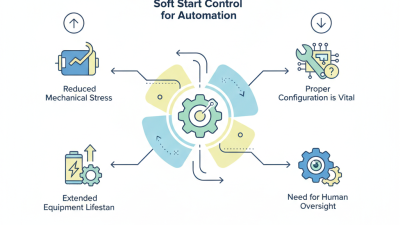
As industries keep pushing forward, there's a pretty clear need for machinery control solutions that are not just reliable but also efficient. One key technology that’s gaining attention is Soft Start Control. Basically, it helps to reduce the mechanical stress when machines turn on, which means your equipment can last for longer. Looking ahead to 2026, big names like Siemens and Schneider Electric are expected to bring some exciting innovations to this space.
Now, Soft Start Control does more than just protect your gear; it’s also great for energy savings. How? It gradually ramps up the power, allowing machines to get started smoothly instead of jamming into full speed instantly. That kind of gentle start can cut down on energy spikes, which adds up to pretty significant savings—definitely a win in today’s economy. But, and here’s the tricky part, figuring out which exact system works best for your specific setup can get a bit complicated.
Choosing the right Soft Start Control isn’t always straightforward. There are different options out there, each with their own pros and cons. You really need to think about your company’s unique needs—like what kind of load you’re dealing with and the environment your machines operate in. It’s often helpful to chat with industry experts who can offer insights and guidance. And don’t forget, keeping an eye on how well the system is working over time will help you make smarter tweaks down the line as the technology continues to evolve.

Understanding Soft Start Control: Concepts and Benefits
Understanding soft start control is crucial for optimizing motor performance. This technique gradually accelerates the motor, reducing mechanical stress and improving lifespan. By minimizing the startup current, users can avoid electrical spikes that often lead to equipment failure. A smooth ramp-up is not just efficient; it ensures the reliability of connected systems.
The benefits are evident in various applications. Industries that rely heavily on motors, such as manufacturing and HVAC, see enhanced efficiency with Soft Start Motor Control. This method mitigates potential damage, leading to lower maintenance costs. However, initial setup can sometimes be complex, requiring careful consideration of motor specifications. Each application demands a tailored approach.
Adopting soft start control is a step towards sustainability. It helps reduce energy consumption during startup, which is often overlooked. Yet, there is room for improvement in user training. Understanding both the advantages and potential pitfalls is essential. Users should be aware that not all setups will yield optimal results without ongoing evaluation. Embracing this control strategy means being prepared for continuous learning and adaptation.
Key Technologies in Soft Start Control Solutions for 2026
Soft start control solutions have gained significant attention in recent years due to their benefits in energy efficiency and machine longevity. In 2026, the market is projected to grow by approximately 12% annually, as reported by industry analysts. This growth is attributed to the rise in automation and the demand for more efficient power management systems across various sectors.
Key technologies shaping soft start controls include variable frequency drives (Vfds) and advanced monitoring systems. VFDs enable precise control of motor speed and torque, reducing mechanical stress during startup. Furthermore, advanced monitoring systems facilitate real-time data analysis, enhancing operational reliability. A recent study indicated that implementing VFDs can lead to energy savings of up to 30%, underlining their importance in modern industrial settings.
There are challenges to consider. Not all installations benefit equally from soft start technology. In certain cases, the initial costs may outweigh long-term savings. Additionally, not all operators fully understand the complexities involved. Thus, education on these technologies is crucial. Engaging with industry experts can ensure correct implementation, maximizing the potential advantages of soft start solutions as we move into 2026.
Comparative Analysis of Leading Soft Start Controllers
The soft start control technology is vital in industrial applications. Its primary function is to reduce inrush current during motor start-up. This not only protects equipment but also prolongs the lifespan of electrical components. A recent industry report noted that implementing soft start solutions can extend equipment life by up to 30%.
Various soft start controllers are available in the market, each with distinct features and capabilities. For instance, PWM (Pulse Width Modulation) controllers have gained traction due to their efficiency. They manage voltage and current buildup effectively, resulting in less energy waste and heat generation. On the other hand, VFDs (Variable Frequency Drives), while often more expensive, provide greater flexibility in control. They can adapt motor speed to load requirements, which can save energy during operation.
Despite their advantages, some challenges persist in choosing the right soft start controller. A common issue is the complexity of integration with existing systems. An effective controller should balance performance with ease of installation. Inconsistent results from different controllers also raise questions about reliability. A thoughtful comparative analysis can help end-users make informed decisions and avoid costly missteps in implementation.
Integration of Soft Start Control in Industrial Applications
The integration of soft start control in industrial applications is becoming increasingly vital. This technology significantly reduces the mechanical stress on equipment during startup. By controlling the initial power supplied to motors, soft starters enhance lifespan and operational efficiency. Workshops and factories can benefit from this seamless integration. It not only minimizes energy spikes but also lowers maintenance costs.
When considering Active Control Soft Start, understanding its capabilities is crucial. Implementing it requires careful planning and expert knowledge. Each application may present unique challenges. Companies should analyze their systems thoroughly. Simple adjustments can yield substantial improvements. Failing to assess specific needs can lead to inefficient setups.
Establishing a baseline for performance is essential. Monitor power consumption and equipment stress during startups. Review adjustments regularly. Learning from operational data helps refine soft start control processes. Investing in training for staff is also vital. Knowledge of the system improves responsiveness. Flexibility to adapt the technology ensures long-term success.
Future Trends in Soft Start Control Technologies
The evolution of soft start control technologies is set to reshape industrial applications by 2026. Industry reports indicate that the global soft starter market is projected to grow significantly, driven by the increasing need for energy-efficient solutions. A recent study found that about 60% of industrial processes now use some form of Soft Start Control Panel to manage motor starts and stops smoothly. This trend reduces wear and tear on equipment, prolonging its lifespan.
Emerging technologies include advanced digital signal processing and integration with IoT systems. These advancements enable real-time monitoring and data analytics.
Reports show that implementing smart controls can enhance energy savings by up to 30%. However, industries must navigate challenges such as installation costs and compatibility with existing systems. While soft start control panels provide substantial benefits, companies may face hesitation in upgrading their systems due to these concerns.
A focus on sustainability is evident in the research. Companies are increasingly seeking eco-friendly solutions that minimize energy consumption and environmental impact.
The transition to greener technologies is not without its hurdles. Many manufacturers need to balance performance with compliance, ensuring they adhere to evolving regulations. These factors will play a crucial role in shaping the landscape of soft start control technologies in the coming years.
Challenges and Considerations in Soft Start Implementation
When implementing soft start control solutions, several challenges arise. Power fluctuations are a common issue, leading to inconsistent performance. Operators may find it difficult to calibrate systems precisely. This is crucial because improper settings can cause motor wear and tear over time. Additionally, many industries lack the expertise required for effective implementation. Workforce training becomes essential yet often overlooked.
Environmental conditions can also create hurdles. High humidity or extreme temperatures may affect the performance of soft start devices. Ensuring compatibility with existing infrastructure is vital. Integrating new controls into outdated systems can result in unexpected downtime. Attention to detail during installation is often neglected. Issues like wiring errors or poor connections can lead to malfunction.
Another consideration is the cost versus benefit analysis. While soft start solutions can reduce energy consumption, initial investments can be high. Companies must weigh the long-term benefits against upfront costs. Stakeholders might resist changes due to fear of disruption. Being aware of these challenges can lead to better planning and execution. Reflection on past implementations can guide future practices.
Choosing the Right Soft Start Solution for Your Needs
Selecting the right soft start solution is critical for optimizing machinery performance. Industry reports indicate that improper soft start control can lead to equipment damage and increased maintenance costs. According to a recent study by the International Electrical Engineering Association, nearly 40% of equipment failures are linked to inadequate start-up processes. This highlights the need for a tailored approach to soft start solutions.
When evaluating options, consider both the application requirements and the technical specifications of various systems. For instance, torque control and motor compatibility should be a focal point. Statistics show that systems designed with precise torque management reduce energy consumption by up to 30%. Moreover, using a reliable Soft Start Control Supplier can enhance performance, ensuring compatibility and longevity of the equipment.
However, not every solution will fit all needs. It's essential to balance cost against functionality. If a system lacks flexibility, it might not adapt well to various load conditions. Reflecting on your specific application is crucial. A misunderstood requirement can lead to over-engineering or underperformance, both costly and time-consuming mistakes. In a rapidly evolving market, being informed will lead to better decisions.
Top Soft Start Control Solutions for 2026
| Solution Type | Key Features | Applications | Estimated Cost ($) | Energy Savings (%) |
| Solid State Soft Starters | High efficiency, compact design, reduced inrush current | Pumps, fans, conveyors | 300 - 800 | 15 - 30 |
| Electromechanical Soft Starters | Simple operation, robust construction, cost-effective | HVAC systems, industrial equipment | 200 - 600 | 10 - 25 |
| Programmable Soft Starters | Customizable settings, digital controls, monitoring features | Manufacturing lines, automotive assembly | 500 - 1200 | 20 - 35 |
| Microprocessor-based Soft Starters | Advanced algorithms, real-time protection, data logging | Industrial automation, robotics | 800 - 1500 | 25 - 40 |
Evaluating the Impact of China LCRVM-C Series Online Soft Starters on Motor Efficiency: Insights from Industry Reports and Market Analysis
The LCRVM-C Series Online Soft Starter represents a significant advancement in motor control technology, addressing the increasing demands for efficiency and reliability in industrial applications. Recent industry reports indicate that the use of soft starters can enhance motor performance by up to 30%, primarily through reducing the inrush current during startup. This reduction not only protects the motor but also minimizes energy consumption, leading to substantial cost savings over time. The LCRVM-C, with its innovative design, has been noted for its effective integration of advanced features that optimize motor operation.
Moreover, a market analysis reveals that the global soft starter market is expected to grow at a compound annual growth rate (CAGR) of approximately 5% over the next five years, driven by rising energy efficiency regulations and an increased focus on sustainable practices in manufacturing. The affordability of the LCRVM-C, paired with its high-quality production standards, positions it well within this expanding market, making it a preferred choice for many companies. As industries seek to improve operational efficiency while controlling costs, the introduction of reliable solutions like the LCRVM-C soft starter is timely and relevant. Adopting such technology not only aligns with current trends but also fosters a proactive approach towards achieving greater energy efficiency in motor applications.
FAQS
: Soft start control gradually accelerates a motor during startup. It reduces mechanical stress and enhances motor lifespan.
Benefits include reduced startup current, lower maintenance costs, and improved efficiency in various industrial applications.
It minimizes energy usage during startup. This reduction is often overlooked yet crucial for sustainability.
Consider application requirements, torque control, and motor compatibility. These factors are vital for optimized performance.
Yes, nearly 40% of equipment failures are linked to inadequate startup processes. This can increase maintenance costs.
Each application has unique needs. A one-size-fits-all approach can lead to inefficiencies and costly mistakes.
User training is essential for understanding benefits and pitfalls. Continuous learning is necessary for optimal performance.
Ongoing evaluation is crucial. Not all setups will yield the best results without regular assessment.
Lack of flexibility may prevent adaptation to varying load conditions, leading to underperformance and inefficiencies.
Misunderstanding can lead to over-engineering or underperformance, which are costly and time-consuming errors.
Conclusion
The article titled "Top Soft Start Control Solutions for 2026 What to Know?" provides an insightful overview of the evolving landscape of Soft Start Control technologies. It begins by explaining the fundamental concepts and advantages of Soft Start Control, such as reducing mechanical stress and improving energy efficiency. Key technologies anticipated for 2026 are highlighted, emphasizing innovations that enhance performance and reliability.
A comparative analysis of leading Soft Start controllers is presented, showcasing their unique features and capabilities. Additionally, the article discusses the integration of Soft Start Control into various industrial applications and explores future trends that may shape its development. Challenges and considerations in implementing these solutions are addressed, helping readers to understand potential obstacles. Finally, guidance is provided on how to select the right Soft Start solution to meet specific requirements effectively.